
Written by: Mack Williams
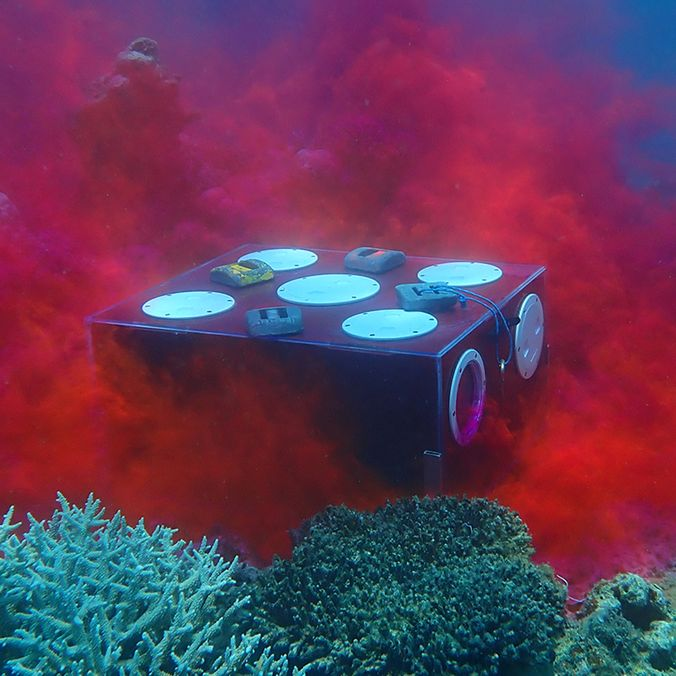
Scientists working on the Great Barrier Reef have created a new tool that could aid in reviving one of the world’s most critically in-danger ecosystems. The coral larval seedbox is designed to dramatically improve the survival of coral larvae which, in turn, could be a critical development in protecting ocean ecology.
After corals release their eggs and sperm during spawning events, the larvae drift into the open ocean, often swept away with the currents. Only a small fraction of these coral larvae manage to attach to a reef bed and grow into adult corals, which proves to be an alarming problem given the ecological implications of mass coral bleaching (Great Barrier Reef Foundation). The seedbox plays a critical role in increasing the larvae’s likelihood of survival: acting like a floating nursery, the seedbox holds millions of coral larvae and releases them near the reef bed gradually, giving them a much better chance to settle successfully on damaged areas of reef beds (CSIRO).
Early trials in November of 2025 near Lizard Island, off the coast of Queensland, Australia have proven incredibly promising. In some areas, coral settlement rates were up to 56 times higher than with traditional restoration methods (Great Barrier Reef Foundation). Researchers are now expanding restoration efforts to the Whitsundays (also northeast of Queensland), testing how effectively the seedboxes function in different environmental conditions and reef regions (Southern Cross University).
This project is a collaborative effort led by CSIRO (Commonwealth Scientific and Industrial Research Organization) and Southern Cross University, with support from the Great Barrier Reef Foundation. Scientists hope that, with time, this surprisingly simple (yet successful) technology could be a scalable and cost-effective solution to conservation efforts for the Great Barrier Reef. With coral reefs under fire from climate change and unsustainable human practice, inducing bleaching events, concepts like the seedbox offer a glowing ember of hope. While the long-term influence of these seedboxes will need to be monitored, the seedbox signifies critical steps in global conservation and sustainable development.
References:
CSIRO. (2025). New larval seedbox technology to drive coral restoration on the Great Barrier Reef. Retrieved from https://www.csiro.au/en/news/all/news/2025/november/new-larval-seedbox-technology-to-drive-coral-restoration-on-the-great-barrier-reef?utm_source
Great Barrier Reef Foundation. (2025). New coral restoration technology helping baby corals beat the odds. Retrieved from
https://www.barrierreef.org/news/news/new-coral-restoration-technology-larval-seedbox?utm_source
Southern Cross University. (2025). Larval seedbox deployment and research. Retrieved from
https://www.scu.edu.au/news/2025/coral-larval-seedbox-technology/?utm_source