
Explore

Creative Solutions for a Sustainable World: Princeton Green Creatives at the Forefront

Author: Mariah Morgan ’27

Where Artistry and Sustainability Meet

Overconsumption is a growing issue that significantly contributes to the staggering amount of waste sent to landfills each year, and the situation is only exacerbated by a culture of disposability and fast fashion. This rampant waste not only depletes natural resources but also poses a severe threat to our environment, leading to increased pollution and greenhouse gas emissions. In the realm of the creative arts, the need for sustainability is paramount, as traditional practices often rely on single-use materials that generate considerable waste. By adopting more sustainable practices, such as utilizing recycled materials and embracing innovative design solutions, artists and performers can reduce their environmental footprint and inspire audiences to think critically about consumption and waste. Not only does this approach preserve the planet for future generations, but it also enriches the creative process, allowing for new expressions of artistry that honor both creativity and environmental responsibility.

Vision and Goals of Princeton Green Creatives

In light of that view, Ava Kronman ’26 founded Princeton Green Creatives. Princeton Green Creatives began in 2024 as a student group whose main goal is to promote sustainable practices within the arts and to encourage a creative approach to addressing climate issues. By providing a space for students to explore the intersection of art and sustainability, the organization hopes to inspire innovative solutions and foster a deeper understanding of environmental challenges. The group is committed to creative advocacy and aims to make both the art and climate spaces more interdisciplinary and inclusive. In Kronman’s words, “We provide a space for creative individuals to engage with climate issues through advocacy and empathy. Our goal is to make art more sustainable by reusing goods and materials and sourcing more sustainable and natural tools.”

The leadership team is headed by Kronman as President, Collin Guedel ’26 as Chief Operating Officer and Treasurer, and Alice Chakrapeesirisuk ’26 as Architecture Chair and Graphic Designer. Currently, the team is actively recruiting leaders for different art positions, including Theater, Music, and Environmental chairs. In our interview with Kronman, we got to hear some of her unique insights into what the group has been up to:

What are some of your major events or accomplishments?
“One of our major accomplishments has been getting the club established and hosting our first interest meeting. We are currently working on recruiting more members and leaders for various arts positions.”

What got you interested in founding Green Creatives?
“I have always been very interested in the environment and in the arts. I wanted to create a space where students can explore this intersection and learn from each other. Princeton welcomes these conversations, and I am excited to build a community around bringing creative minds to the environmental problem solving table and bringing scientific research to art making processes.”

What are some upcoming events or projects the group will be working on?
“We are planning to invite speakers from various fields, such as Broadway and architecture, to share their insights. We also aim to hold art workshops, such as making reusable tote bags and make-up removers using natural materials. Additionally, we hope to collaborate with the Green Broadway Alliance and participate in Earth Day activities on campus.” They also plan to lead a redecoration project for the Ecolounge, which will include a new mural representing all the sustainability groups. 

Getting Involved

Princeton Green Creatives is dedicated to bridging the gap between the arts and sustainability, offering a collaborative space for innovative solutions and environmental advocacy. For more information or to get involved, follow their social media accounts,  join their club page on MyPrincetonU, and listserv, or contact Ava Kronman directly at ak6060@princeton.edu. Stay tuned for their upcoming events and projects this fall!


Citations:

Environment, U. (n.d.). Sustainability. UNEP. https://www.unep.org/about-un-environment/sustainability 

Environmental Protection Agency. (n.d.-a). EPA. https://www.epa.gov/facts-and-figures-about-materials-waste-and-recycling 
AI & Climate Change: Harnessing Technology for a Sustainable Future

Author: Ezekiel Akinsanya ’26

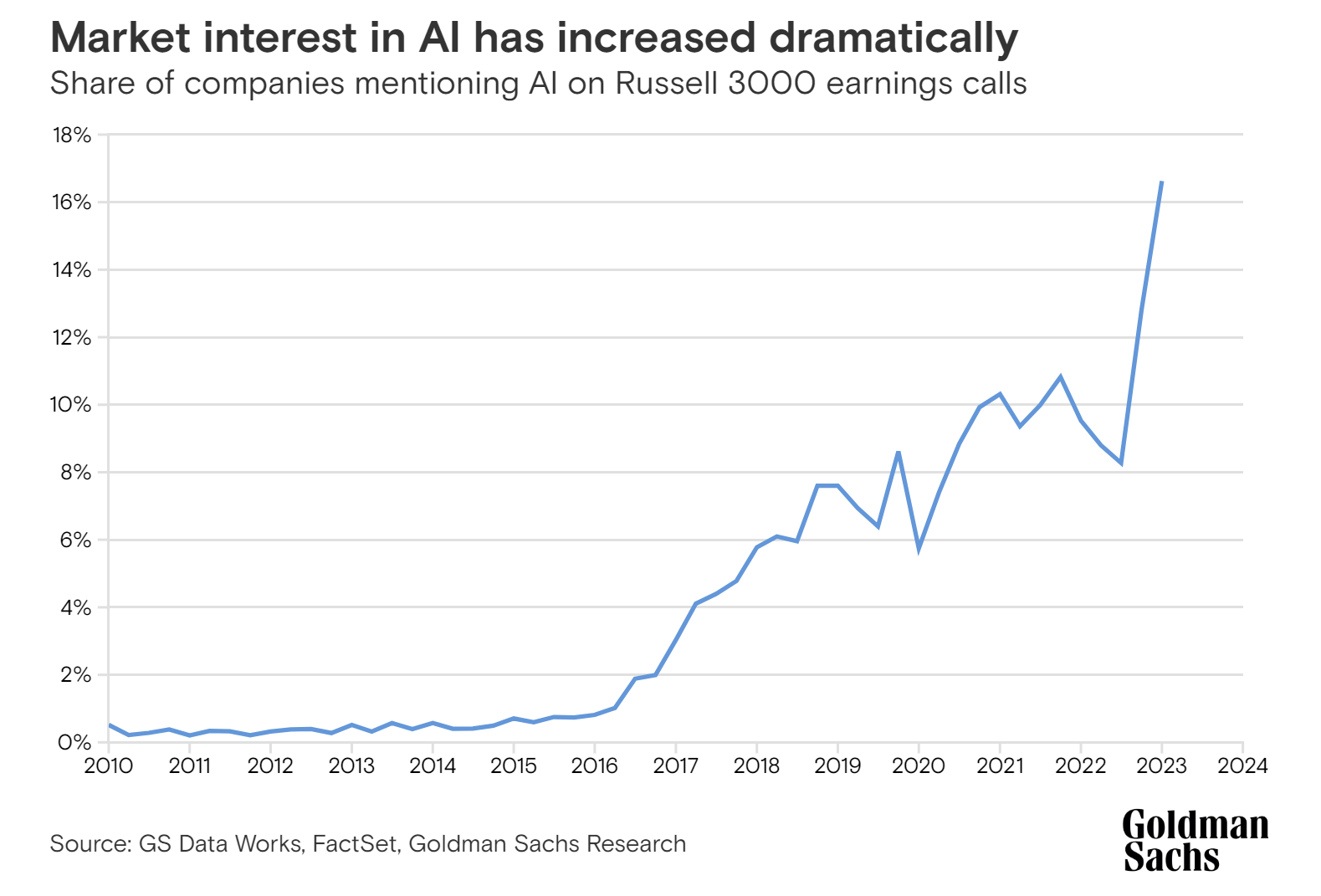
Since the release of OpenAI’s ChatGPT in 2022, enthusiasm about the seemingly endless possibilities of artificial intelligence has taken the world by storm. AI is certainly not a new technology, but technological breakthroughs for large language models over the past 12-18 months have spurred excitement for essay-writing students and magnificent seven* shareholders alike; placing a new spotlight on the technology.

*The “Magnificent Seven” stocks are the cornerstone of today’s tech market. These stocks include Amazon, Alphabet, Apple, Meta Platforms, Microsoft, Nvidia, and Tesla

Graph showing the change in the share of companies mentioning AI on Russel 3000 earnings calls.

All this attention has led to massive growth in the level of investment in AI, 2021 saw almost $280 billion of global corporate investment into AI1; this is roughly the same as the GDP of Finland and represents a 30x increase in investment from 2013. But what does this have to do with climate change?

With every year that passes, new research is published that suggests that the world is edging nearer to the point of no return. More people are turning towards climate activism now than ever before in the wake of the current climate disaster. Still, others have been patiently waiting for a breakthrough technology that will help us make the significant progress necessary to mitigate climate change completely (or just enough that we don’t wipe ourselves out), and artificial intelligence could be just that. One reason for our slow progress in this battle is the complexity of climate data; climate data sets are massive, and take a long time to collect, analyze, and interpret before top-down decisions can be made. But guess what technology does just that (hint: it starts with an A, and ends in an I), and a whole lot quicker than we’ve ever been able to.

Data Collection and Analysis

Oceans are arguably the only reason that we haven’t already wiped ourselves out as a result of climate change; absorbing 90% of the excess heat that we’ve created and 23% of human-related CO2 emissions2. However, our understanding of the ocean is extremely limited, not only because we have only explored 5%3 of it, but due to how difficult it is to process the vast amounts of oceanographic data that exists. Machine learning algorithms can help identify patterns and predict changes in the ocean that will be crucial in helping us understand climate change. In addition to this, AI can be used to analyze satellite imagery to detect plastic and oil pollution, assess its extent, and predict its spread. This will be crucial in minimizing further environmental damage and is only one example of the potential of this technology to tackle climate change.

Improving efficiencies

Remember in 2021 when that ship got stuck in the Suez Canal? That caused an additional 6,847 tonnes of excess CO24 to be emitted into the atmosphere. Predictive analytics is another place where AI can be useful in our battle against climate change. Of course, AI is not going to reveal the secrets of the future to us (yet…), but by tracking events with the potential to impact supply chains, AI can increase the speed of adaptation to supply chain disruptions as well as help optimize shipping routes following these disruptions; both of which will help reduce our consumption of fossil fuels and in turn our emissions.

Looking at the micro picture, AI also serves as a useful tool to help businesses improve their material, energy, and labor efficiency. This will be particularly important in the renewable energy space to help these companies reduce their costs and in turn the green premium** on their goods; making it easier for other companies and individuals to make the switch towards greener alternatives

Forecasting Natural Disasters

12,000 lives were lost in 2023 as a result of climate-related natural disasters5. For a long time, our methods of predicting these natural disasters were weak, and a region’s ability to prepare for these disasters heavily depended on how wealthy that region was, resulting in various forms of climate inequality. The ability of AI to crunch massive amounts of data creates ample opportunity to improve the predictive models used to analyze climate and weather patterns. The development of this technology can help improve disaster prediction and prevention strategies and potentially save thousands of lives each year.

Complications

Despite all of these potential uses of AI to combat climate change, I would be lying if I said it was all sunshine and rainbows. Researchers at the University of Massachusetts, Amherst have found that the training process for one AI model can emit more than 600,000 lbs of CO26 due to how energy-intensive this process is. Getting this number down will require aggressive investment into renewable energy and the integration of this energy onto the grid. As AI improves efficiencies for renewable energy companies, it also does so in the same way for much larger traditional energy players making it more difficult for renewable companies to gain price parity with traditional players. Finally, there is still a large amount of skepticism surrounding AI across the board. It doesn’t help that large language models are still in their early stages and have been seen generating some well… questionable content. 

Final Thoughts

In summary, the recent explosive growth in AI has created more opportunities for us to right our wrongs to the planet and future generations. The technology is still in its early days which inspires optimism for the full extent of the good it can do; but it will require a proactive approach from researchers, companies, and regulators (who haven’t been shy in expressing their concerns). You can also make a difference in this space. Whether it’s pursuing a job in climate tech, carrying out academic research, or stewarding capital towards businesses focused on making an impact; we all have a part to play in the journey toward saving our planet!

  1. Artificial intelligence has advanced despite having few resources dedicated to its development – now investments have increased substantially – Our World in Data
  2. What You Need to Know About Oceans and Climate Change.
  3. How much of the ocean has been explored? Surprisingly little – Interesting Engineering
  4. This is how much excess CO2e the Suez Canal blockage caused – The Eco Experts.
  5. 2023 In Review: Climate disasters claimed 12,000 lives globally in 2023 – World | ReliefWeb
  6. Some experts see AI as a tool against climate change. Others say its own carbon footprint could be a problem. – CBS News

Financing Sustainability: A Princeton Alumna’s Perspective on Shaping a Greener Future

Authors: Sunrit Panda ’25 & Jason Luo ’25

In an enlightening conversation, Amber Mahone GS ’07, a Princeton alumna and managing partner at the environmental consulting firm E3, shared her insights on the critical role of finance in steering the world toward sustainability. As members of the Office of Sustainability and EcoRep leaders at Princeton University, we had the opportunity to explore with Mahone the intricate relationship between financial mechanisms and environmental goals.

Image Credit: E3

Understanding the Finance-Sustainability Nexus

Mahone passionately describes the intersection of finance and sustainability, emphasizing its indispensability by expressing  “In order to achieve a more sustainable future, we need money to finance that transition.” She underscores the challenge posed by the initial capital required for clean energy and sustainable solutions. Despite long-term savings and broader societal benefits, these initiatives demand financial backing to transition from a fossil fuel-based economy to a greener future.

Strategic Projects Paving the Way

Mahone’s recent work with the state of California exemplifies practical approaches to sustainability. “I recently supported the state of California in developing their plan … to a net-zero future by 2045,” she shares. This project required a comprehensive evaluation of strategies across the energy sector, focusing on solutions for low-income customers and financing for renewable energy and transmission infrastructure. Her work highlights the complex layers involved in realizing a net-zero emissions target.

Image Credit: Tom Swinnen

State-Level Progress and Comparative Analysis

In discussing the progress of various states towards sustainability, Mahone discussed some other states that share California’s ambitious goals. “Well, New York state is right up there with California. They are neck and neck in terms of ambition,” Mahone acknowledged. Her experience in supporting New York’s scoping plan, alongside other states and universities like Princeton, reflects a growing national movement towards sustainability. “I really see this accelerating in terms of corporations, private institutions and states taking action to fill the void where the federal government hasn’t been able to do much,” Mahone observes, while highlighting a shift in responsibility towards smaller entities.

Global Aspirations for Clean Energy

When asked about her hopes for clean energy globally, Mahone emphasizes the urgency of the situation. “We need to achieve net zero and climate stabilization,” she asserts. It’s more than a hope; it’s an imperative. She acknowledges the challenges, particularly the existing system’s inertia around fossil fuels. “It’s going to take a lot of capital, a lot of policy, a lot of individual actions to make that transition,” Mahone explains, calling for widespread involvement from all societal sectors.

A Personal Path to Bridging Finance and Sustainability

Reflecting on her journey, Mahone credits her undergraduate experiences and her time at the IMF (International Monetary Fund) as formative in her understanding of sustainability’s financial aspects. “I saw how much fossil fuels and the need for fossil fuels drove the future of these companies,” she recalls. Her reading of Daniel Yergin’s “The Prize: The Epic Quest for Oil, Money, and Power” during high school was a turning point, helping her grasp the profound impact of energy on global politics. “If we can change, you know, that narrative, we’ll have a very different world that is hopefully more sustainable,” she reflects.

Conclusion

Amber Mahone’s perspective as a Princeton alumna and environmental consultant offers a unique lens into the complex relationship between finance and sustainability. Her experiences and insights underscore the necessity of innovative financial solutions to support the global transition to a sustainable future. This conversation not only highlights the critical role of finance in environmental efforts but also serves as a call to action for institutions, states, and individuals to contribute to this vital movement.

Read the full interview transcript below:

In your own words, how do you describe the intersection between finance and sustainability (ESG)?

So, in order to achieve a more sustainable future we need money to finance that transition. Clean energy and the more sustainable solutions, they often come with an upfront capital cost. Even if there are savings over the lifetime of the equipment, even if there are long term societal benefits, there’s still an upfront capital cost that requires a financial solution. And so financing is essential to transition us away from a fossil fuel economy to a sustainable future.

What is a project you’ve worked on recently and how did it lead to cleaner energy and a more sustainable future?

I recently supported the state of California in developing their plan, they call it their scoping plan to a net zero future by 2045. And that involved looking across the entire energy economy to evaluate what are the strategies and solutions needed to hit that net zero target. So, there’s a lot that goes into that. But um, coming up with solutions to support low-income customers is part of that transition. Coming up with ways to finance the renewables, finance the transmission, those are all necessary to achieve net zero in California, and that’s something we looked at closely.

I imagine California is pretty robust and they are ahead of many other states in terms of getting to Net Zero carbon emissions. Is that statement true?

Well so, New York state is right up there with California. They are neck in neck in terms of ambition. And, we supported New York in their scoping plan. There’s actually a lot of states that are taking action and a lot of universities as well. And, it’s great to hear that Princeton is a part of that effort. I really see this accelerating in terms of corporations, private institutions, states, taking action to fill the void where the federal government hasn’t been able to do much.

What hopes do you have for clean energy in our global future?

We need to achieve net zero and climate stabilization. It’s not a hope as much as it is an imperative. There are a lot of challenges though to get there, and a big one is the inertia in our existing system around fossil fuels. And, it’s going to take a lot of capital, it’s going to take a lot of policy, it’s going to take a lot of individual actions to make that transition. But it’s every company, it’s every person, it’s every individual has a role to play in that transition. That’s my hope that more people and more companies get involved.

How has your personal journey led you to a career that bridges finance, consulting, and sustainability?

Yeah well I think it started when I was in undergrad. I did a program where I traveled around the world to different countries, and we were spinning sustainable development. And I saw how much fossil fuels and the need for fossil fuels drove the future of these companies. And when I worked at the IMF that was a big theme there as well, just the role of fossil fuels in developing countries’ financial outlook. And so that brought around the idea that the U.S. can play such an important global role in changing that trajectory. So, that’s maybe the other thing I will add actually is when I was in high school I read this book called “The Prize” by Daniel Yergin… It’s excellent, you should check it out if you haven’t seen it. But it’s all about how energy has shaped the history of the world, and that was an ‘aha’ moment for me when I realized, okay, energy is such a power force in global world wars and the shaping of global geopolitics. If we can change, you know, that narrative, we’ll have a very different world that is hopefully more sustainable. You should really read “The Prize.”

Tracing Traceability

Author: Aditi Desai ’24

Traceability is the process of identifying and tracking a product’s creation process from raw material to finished goods. Conveying traceability data is an extremely useful tool to communicate information about the product as it moves through the value chain. Traceability is a particularly impactful tool for advancing sustainability objectives, but it still has a long way to go before it is an integral part of sustainable supply chain management, and before it is widely used by companies. 

Image credit: Bhushan Suryawanshi

[Part 1]: How does traceability advance sustainability in global supply chains?

Although traceability schemes have slightly different definitions, they all reference a process by which a product moves from its original raw material extraction and production phase to the final customer. The original ISO definition of traceability is “the ability to identify and trace the history, distribution, location, and application of products, parts, and materials.”

In the context of sustainability, traceability is a tool to assure and verify sustainability claims associated with commodities and products, ensuring good practice and respect for people and the environment all along the supply chain. The value of traceability with regard to sustainability comes from the realizability of information coming from a traceable system. For example, schemes ensuring that minerals are not sourced from conditions of armed conflict (known as “conflict minerals”) aim to address the human rights abuses in conflict areas and avoid purchasing materials that can directly or indirectly finance and increase the intensity of those conflicts. Programs that certify the use of products that are grown in sustainable cultivations, whether they relate to food (e.g., cocoa, nuts, or coffee) or to other commodities (e.g., cotton or wood), can have numerous effects on the environment, from the reduction of carbon footprints to the prevention of deforestation.

[Part 2]: What does traceability look like today?

With current technology available to trace each raw material that goes into a product and follow how a product is used and where it is discarded, traceability has emerged as both a feasible and effective front. In fact, digital traceability enables companies to meet and balance a broader set of business objectives, including efficiency, resilience, responsiveness, and sustainability. Across most industries and sectors, we are already starting to see companies with traceable supply chains. For example, in the pharmaceutical industry, WHO estimates that around 11 percent of medicines in developing countries are counterfeit and that “anywhere from 100,000 to a million people die each year due to falsified drugs” (World Economic Forum). Recalls of medications are often unavoidable when a product is contaminated or deemed unsafe. Thus, traceability provides a potentially life-saving informational perspective on pharmaceutical products, such as status confirmation and expiry date. 

[Part 3]: How do we make traceability more transparent? [Case study in the menstrual industry]

Companies are rushing to more closely track materials across their supply chains (due to new regulations and environmental laws). To dive into an industry-specific example, over the past few years, feminine hygiene products have been turning up contaminated by PFAS, short for per- and polyfluoroalkyl substances. These “forever chemicals” are ubiquitous and persistent manufacturing chemicals that have been linked to a range of health issues by the EPA. In a series of analyses commissioned between 2020 and 2022, it was found that 48 percent of sanitary pads and liners were found to contain PFAS. Thus, there has been a major push to develop cleaner and more sustainably made period products, such as menstrual cups and underwear. 

In the realm of menstrual products, the company August has demonstrated the power of traceability and digital communication to its users through its online platform. Moreover, Aisle is another sustainable period product company that prioritizes traceability as demonstrated through its partnership with the B-corp certification. This allows a third party to run a comprehensive analysis of Aisle’s supply chain, the sourcing of their materials, and their after-life product management. Having a non-biased standardized source means more transparency between the companies and consumers and accountability for said companies. 

Image Credit: Aisle

For Aisle, sustainability means that the company’s products are made using traceable raw materials verified by their cradle-to-grave tracing processes. In other words, it’s not just about the textile that period garments are made of, but the process that gets the products to the consumer. 

Traceability, while a technical term, allows consumers to track the cycle of a product. This comprehensive insight helps those wanting to support sustainable companies, and “vote with one’s dollar.”

EJ implications of the Earthquake in Turkey and Syria

Author: Jayla Cornelius ’23

On February 6th at 4:17 am, destruction hit both the south-central Turkish city of Nurdağı and the Syrian city of Jinderis. Tectonic plates stretching eleven miles underneath this city began moving side by side in opposite directions which, in geological studies, is referred to as a strike-slip fault. The Arabian and Anatolian plates moved past each other and weakened the structural integrity of ten neighboring cities in the area. In the middle of the night, the fault yielded and the crust began to crack, releasing stored energy that was the equivalent of “roughly 8 million tons of TNT.” 23 million people have been directly affected and 7,000 of those residents have been declared deceased. Those near the epicenter of this 7.8 magnitude earthquake stood by in mourning, some of which took shelter in their cars, and waited for the possible aftershock of this already gruesome natural phenomenon. For those unfamiliar, aftershocks commonly take place after the main quake but as time passes and the earth begins to settle, they become increasingly rare. You can think of an aftershock as a reverberation in the earth’s crust as seismic waves (which dissipate the further you are from the epicenter) travel in a curving path due to changes in composition, pressure, and temperature within the layers of the Earth. The most dangerous period after the quake usually takes place within three days of the main shock for inland earthquakes such as the one in Turkey and Syria. For earthquakes occurring in the sea area, they can be seen as much as ten days later.

On February 15th, Sean Kivlehan, assistant professor of Global Health and Population at Harvard, spoke about his Harvard Humanitarian Initiative (HHI) and how shelter remains a huge concern in multiple areas of Syria which was already going through a separate humanitarian crisis. The health system was deemed fragmented and inadequate even prior to the earthquake and the level of aid required only skyrocketed further. The interruption of work and  limited/nonexistent access to education force people to relocate to unknown and possibly more dangerous environments. These sensitive events surrounding Turkey and Syria have affected people all over the world and the uncertain future of both the infrastructure and economy leaves many people restless and worried. 

As an environment-related blog, we hope to not only inform students about the events occurring all over the world but also emphasize the emotional toll that such events take on a number of us. The devastation ravaged on these Turkish and Syrian cities can be mitigated with more effective enforcement of building code regulations that require infrastructure plans to meet a certain standard before beginning construction. While we cannot change the past, we can learn from these events and require that both politicians and developers in cities all over the world provide an adequate level of diligence when attempting to sign off on plans that may not be up to standard for the area. This post is not meant to dive into the structural reasons of why more buildings than necessary collapsed during this event, but it is important to know that you can also help by focusing on the engineers tasked with building these structures as a way to advocate for environmental justice. For the Turkish and Syrian aid relief specifically, organizations seeking to provide aid should be in correspondence with the United Nations Office for the Coordination of Humanitarian Affairs (UN OCHA). As always, please visit the links below and/or explore articles on your own to stay informed. 

Helpful Links:

https://www.npr.org/2023/02/07/1154913148/turkey-earthquake-fault-lines-syria#:~:text=This%20was%20a%20%22strike%2Dslip,sliding%20past%20the%20Anatolian%20Plate.

https://www.npr.org/2023/02/11/1156305956/earthquake-survivors-in-northern-syria-already-ravaged-by-war-are-unable-to-rece#:~:text=Ghaith%20Alsayed%2FAP-,People%20walk%20past%20collapsed%20buildings%20on%20Thursday%20in%20the%20town,massive%20earthquake%20devastated%20the%20region.

https://www.theatlantic.com/science/archive/2023/02/turkey-earthquake-death-toll-seismic-waves/672978/

Good News Friday 3/10/23 – High Seas Treaty Protects Marine Wildlife

Author: Ezekiel Akinsanya ’26

Image Credit: Elianne Dipp via pexels.com

Welcome to the first edition of Good News Friday in 2023! Today we’re taking a look at the “High Seas Treaty”, the latest agreement to come out of the United Nations. The treaty centers on protecting the ocean and marine wildlife.

71% percent of our world is covered in water, with 97% of this water coming from our oceans. Who’s in control of the various oceans around the world has historically been one of the most contested areas within international law. The United Nations Convention on the Law of the Sea (UNCLOS) has established that a nation’s territorial sea extends 12 nautical miles from its coastline, with an additional 200 nautical miles designated as an exclusive economic zone (EEZ). However, this framework only applies to one-third of the world’s oceans. The remaining two-thirds are facing threats such as overfishing, shipping traffic, and the impact of climate change, rendering the majority of the ocean to decline.

Talks on protecting international waters started in 2004, but currently, only 1% of international waters are being protected. Saturday, March 4th 2023 marked the most significant progress we’ve made towards protecting international waters in what is being coined the “High Seas Treaty.” This legal framework presented by UNCLOS will work towards protecting 30% of the world’s oceans by regulating deep-sea mining, changing shipping routes, and investing in marine conservation. This agreement comes as part of a host of efforts to work towards The 2030 Agenda for Sustainable Development (SDG 14).

Image Credit: Niklas Jaromin via pexels.com

According to the International Union for Conservation of Nature, 10% of marine species were found to be at risk of extinction, and Dr. Ngoze Oguguah, the chief research officer at the Nigerian Institute for Oceanography and Marine Research claims “the two biggest causes [of extinction] are overfishing and pollution.” It is crucial that we protect these species because over a quarter of our emissions are absorbed by the ocean. A single whale, for instance, can sequester 33 tons of carbon, which is comparable to the yearly absorption of almost 1500 trees.

Additionally, in a post-pandemic environment where the effectiveness of globalization is being questioned, this international cooperation is a massive success. The treaty also pioneers equitable climate policy; wealthy nations are pledging money to ensure the delivery of the treaty and will support developing countries in adhering to the treaty. Notable examples are the EU and the US announcing nearly €820 million ($872 million) and $6 billion respectively for international ocean protection.

However, the treaty doesn’t call for sunshine and roses just yet, the level of protection that will take place remains unsolved. Dr. Simon Walmsley, the marine chief advisor of WWF-UK said that “there was debate, particularly about what a marine protected area is. Is it sustainable use or fully protected?” Despite the progress the Treaty has made, there is still work to be done and we must continue to address these challenges and work toward finding solutions that will protect the marine environment and support life for generations to come.

That’s all for this week! Check back next week (or after spring break) for more encouraging environmental news. If you’d like to share some good news with us, please feel free to get in touch!

Sources:

https://news.un.org/en/story/2023/03/1134157

https://www.noaa.gov/maritime-zones-and-boundaries

https://www.bbc.com/news/science-environment-64839763

https://news.yahoo.com/un-high-seas-treaty-why-030328266.html

https://www.theguardian.com/environment/2023/mar/05/high-seas-treaty-agreement-to-protect-international-waters-finally-reached-at-un

https://www.imf.org/en/Publications/fandd/issues/2019/12/natures-solution-to-climate-change-chami

https://sdgs.un.org/goals

https://www.euronews.com/2023/03/03/eu-and-us-pledge-funds-to-protect-oceans-at-panama-conference

Meet the EcoReps – Isabella Checa ’25

Hometown – Quito, Ecuador

How do you engage with sustainability?

The main way I engage with sustainability is through talking about environmental problems on a daily basis with the people in my life. I believe that the best way to fight large-scale problems such as climate change is to communicate them in a way that more people start caring more about the environment. 

What do you study and why?

I study Geoscience, especially in the Ocean and Atmospheric Sciences track because I genuinely get excited about learning how our planet works/worked in the past or when environmental problems are related to human social issues. I am passionate about learning about these issues and thinking about ways where I can help solve them in the future. 

What other campus groups are you involved with?

Around campus, you can see me involved in the Princeton Conservation Society, Service Focus as well as Más Flow Dance Company, and the Jazz Vocal Ensemble.

What do you like to do in your free time?

I play guitar, sing, and watch movies with my friends 🙂 

Share a fun fact about yourself!

I got my scuba diving certificate this last summer! 

Meet the EcoReps – Ruth Rocker ’26

Hometown – New York, NY 

How do you engage with sustainability?

I maintain mindful practices about my daily consumption and waste, like always seeking to buy second hand and eating a vegetarian diet. To me, a big part of sustainability is being kind to others and to yourself, so I’m always looking for ways to exercise my sustainability goals that are fun and collaborative.  

What do you study and why?

I am interested in studying anthropology because I am eager to study how cultural systems shape our world. I am also interested in gender and sexuality studies and urban studies because I would like to study the intersections between these disciplines and anthropology. 

What other campus groups are you involved with?

I am a Peer Educator for the Princeton Gender + Sexuality Resource Center. I am also a core volunteer for the Princeton Students for Reproductive Justice. I am also a very enthusiastic member of the Ballroom Dance Club! 

What do you like to do in your free time?

In my free time I love to cook with my roommates and go on walks around Princeton! 

Share a fun fact about yourself!

I am very proud of my dorm’s second hand couch that I got for free on Craigslist! 

Meet the EcoReps – Makenzie Hymes ’26

Hometown – Falls Church, VA 

How do you engage with sustainability?

I engage with sustainability through remaining conscious of my actions as an individual and their possible impacts on the environment. I also consider the ways in which sustainability can influence areas outside of the environment including racial justice and gender based discrimination.  

What do you study and why?

I am studying Public Policy with certificates in African American Studies and possibly Spanish Language & Culture because I want to help create positive change while working within the legal system for people who have been negatively impacted by fixable problems.  

What other campus groups are you involved with?

I dance with 3 on campus dance groups: Princeton University Ballet, BodyHype Dance Company, Black Arts Company. I am also a member of Students for Prison Education Reform and Generational African American Student Association.    

What do you like to do in your free time?

In my free time I enjoy listening to podcasts, riding my bike around campus, and spending time with friends!  

Share a fun fact about yourself!

A fun fact about myself is that I have danced since I was 4 years old! 

Meet the EcoReps – Mariam Elawady ’26

Hometown – Chino Hills, CA

How do you engage with sustainability?

In my day to day life, I engage with sustainability by overall carrying myself with environmental consciousness. Doing little things like making sure to recycle my coffee cups, being conscious about my water use, and turning off the lights in my dorm room help me reduce my footprint and be as sustainable as possible. I also try to keep myself educated and updated on sustainability, whether it be on campus or as a global citizen.

What do you study and why?

I am considering majoring in either mol bio or EEB because I have always been really passionate about the living sciences. Not only is biology fascinating, but it can be used to make such a big impact on the world around us.

What other campus groups are you involved with?

Besides being a busy student and an EcoRep, I am also involved in the Princeton Arab Society as the social chair!

What do you like to do in your free time?

In my free time (when I have it) I love painting, going on walks, binge watching Netflix, and staying up talking to my friends.

Share a fun fact about yourself!

I have a twin brother, I did mixed martial arts for 6 years, and I am trying to visit every continent by the end of my college career!